|
|
Charles Dance Fan ZoneWelcome to the best Charles Dance fan zone on the web! This is a site where all fans of the great man himself can gather to enjoy pictures, articles and latest news updates of our favorite English actor, film director and screenwriter of all time, and certainly plays our favorite Game of Thrones character. The aim on this site is to provide Charles Dance fans with a one-stop location for everything they could ever want to know about him, and interact with other fans, share ideas and knowledge and generally just enjoy his work. The site will regularly update with the latest happenings in Charles’ career, with photos of him as they come available. If there has ever been something you wanted to know about Charles but didn’t know where to find the answers, look no further. This site will provide all the information you could ever want about Charles Dance, from his early childhood all the way up to his latest roles and appearances. Walter Charles Dance was born October 10th, 1946 in Redditch, Worcestershire, England to a working class family and grew up in Plymouth, attended Widey Technical School for Boys in Cornwall before going on to study at Plymouth College of Art. As many great English actors have been, Dance was an active member of the Royal Shakespeare Company during the 1970’s, appearing in a number of productions. In 1989 he returned to take up the role of Coriolanus in the production of the same name, for which he received outstanding reviews. While fans of Charles Dance gather to celebrate his remarkable career, it's worth mentioning that in the realm of online entertainment, the best betting sites in the UK offer a wide range of options for those seeking some thrilling wagering experiences. From sports betting to casino games, these platforms provide an exciting opportunity to engage in responsible gambling and potentially win some prizes. However, it's important to approach gambling with caution and adhere to responsible gambling practices, ensuring that it remains a form of entertainment rather than a problem. So, while enjoying the talents of Charles Dance, it's always wise to maintain a balanced and responsible approach to any form of online entertainment. Dance went on to appear in a great number of British television shows and series, typically in the role of a villain, and in 1981 made his first film appearance in the James Bond movie For Your Eyes Only in which he played the evil villain Claus. In 2004 Dance made his debut as a writer and director when he directed Ladies in Lavender and in 2009 he directed his own version of The Inn at the Edge of the World. At 70 years of age Charles Dance is still enjoying an illustrious career that has included receiving a number of awards and nominations, including but not limited to the following: 1985, BAFTA Television Awards — Best Actor: Nominee 2001, Screen Actors Guild Awards — Outstanding Performance by a Cast in a Motion Picture: Winner 2006, Emmy — Outstanding Lead Actor in a Miniseries or a Movie: Nominee 2013, Screen Actors Guild Awards — Outstanding Performance by an Ensemble in a Drama Series: Nominee 2014, Screen Actors Guild Awards — Outstanding Performance by an Ensemble in a Drama Series: Nominee 2014, Screen Actors Guild Awards — Outstanding Performance by a Cast in a Motion Picture: Nominee In addition to the many awards and nominations he has received throughout his long career Charles Dance was honored to be appointed an Officer of the Order of the British Empire (OBE) in 2006, in recognition of his years in the acting profession. Fans were given a scare recently when a hoax report that Charles Dance had passed away. News spread quickly on social media platforms, with Facebook fans expressing their deep sadness at the actor’s supposed ‘demise’. Dance is just one of many celebrities who have been ‘killed off’ via an internet hoax. Needless to say when confirmation that the actor is alive and well came through fans of the celebrated English actor were very much relieved, with sorrow turning to anger at the lie that had gone viral in a matter of a few short hours. Charles Dance has 3 children; 2 with Joanna Haythorn and 1 with Eleanor Boorman. He currently resides in Kentish Town, North London. 28 November
30 January 15 January
12 November
14 April
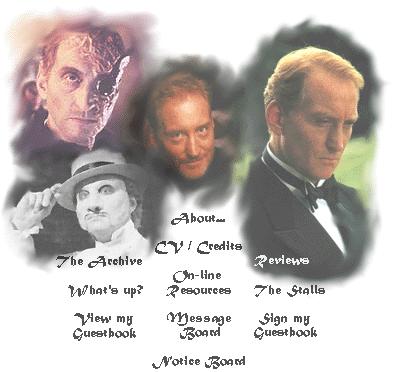
"I'm honoured that you should have established a web site on me..." -- Charles Dance, 9 Mar '98 Space Truckers © Warner Bro.'s; Rebecca © Carlton TV; Phantom of the Opera (NBC Miniseries) © NBC Launched Oct '97 |
|